Quick answer: Calculate what you own, subtract what you owe right now — the amount left is what you pay Zakat on. If that amount equals or exceeds the Nisab threshold and you've held at least that much for one full Hijri year, multiply it by 2.5% to get the Zakat you owe. You can calculate it manually using the steps below, or use LaunchGood's free Zakat Calculator to get an instant, accurate figure in your local currency.
What is Zakat, and how much do I owe?
Zakat is an obligatory annual payment of 2.5% of a Muslim's zakatable wealth, due once that wealth has remained above the Nisab threshold for one full Hijri (lunar) year, known as the Hawl.
The formula is simple:
What you own − What you owe = What you pay Zakat onWhat you pay Zakat on × 2.5% = Zakat you must pay
- Rate: 2.5% of what's left after subtracting what you owe
- Nisab: based on the value of silver, which fluctuates with the market — LaunchGood's calculator uses the current live rate, and shows it to you before you start (for reference, Nisab is roughly $1,200 USD at time of writing, but check the calculator for today's exact figure)
- Hawl: a full Hijri year during which your zakatable assets stayed at or above Nisab
If what's left after subtracting your debts is below Nisab on your Zakat due date, no Zakat is owed that year.
What assets do I include when calculating Zakat?
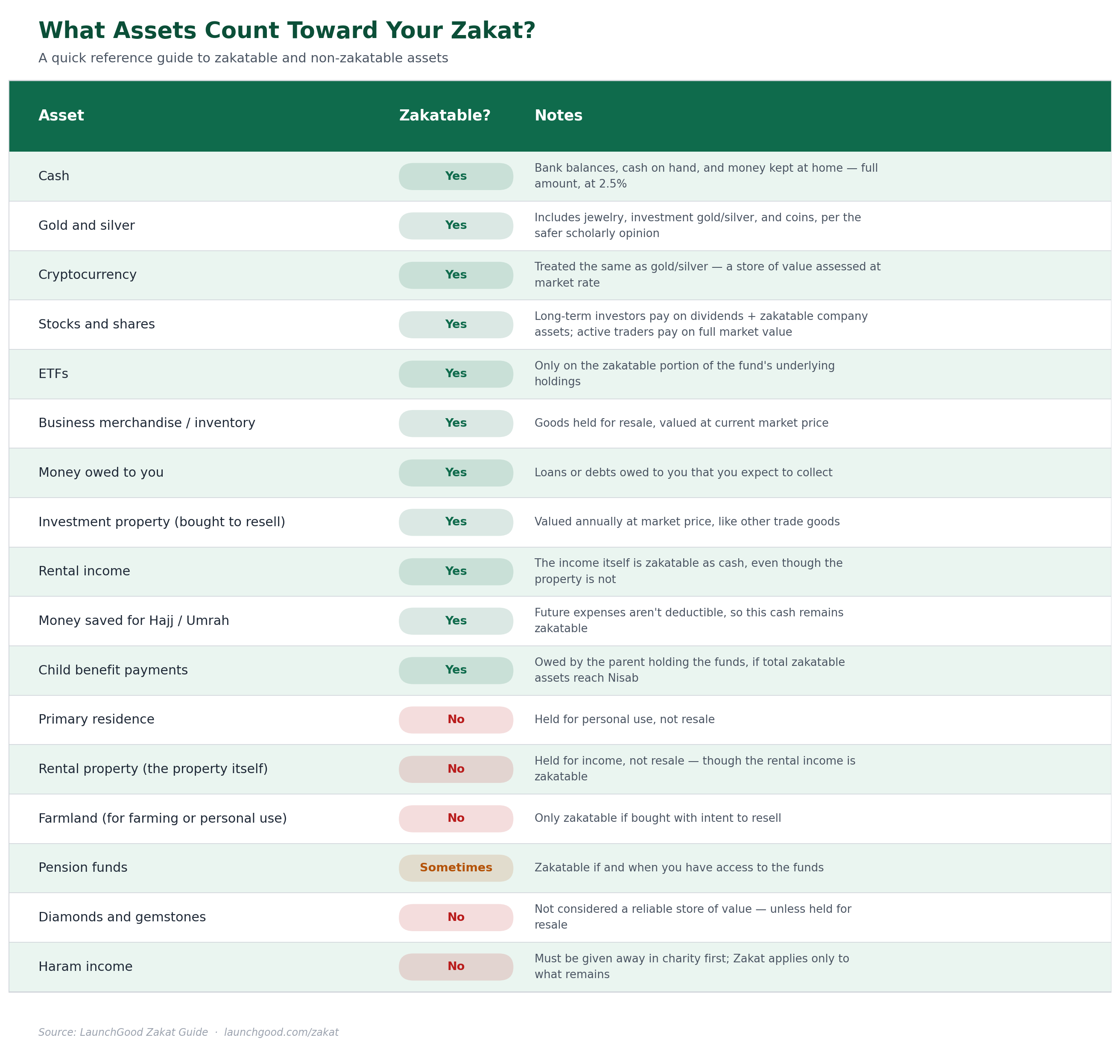
Not everything you own counts toward Zakat. Personal-use items — your home, car, clothing, and furniture — are excluded. Zakat applies specifically to wealth that is stored, invested, or held for trade.
LaunchGood's Zakat Calculator groups your zakatable assets into five categories:
- Cash — Bank balances, cash on hand, money "under the mattress." Zakatable: yes, full amount.
- Gold and silver — Investment gold/silver, jewelry, coins, by weight (grams) or cash value. Zakatable: yes, per the safer scholarly opinion — see below.
- Investments — Stocks, shares, ETFs, crypto, and other holdings. Zakatable: yes, calculated based on your specific holdings.
- Money owed to you — Loans or debts others owe you that you expect to be repaid. Zakatable: yes, if collectible.
- Business merchandise — Cash or liquid assets tied to a business, plus goods held for resale. Zakatable: yes, at current market value.
A few common assets that fall outside these categories are worth calling out specifically:
- Primary residence, rental property — Held for use or income, not resale. Zakatable: no (but rental income itself is zakatable as cash).
- Investment property bought to resell — Valued annually at market price, treated like business merchandise. Zakatable: yes.
- Farmland (for farming or personal use) — Only zakatable if bought with intent to resell. Zakatable: no.
- Pension funds — Zakatable if and when you have access to the funds. Zakatable: sometimes.
- Diamonds and gemstones — Not considered a reliable store of value under most scholarly opinions, unless held for resale. Zakatable: no.
- Money saved for Hajj/Umrah — Future expenses aren't deductible; this cash is treated like any other zakatable cash. Zakatable: yes.
- Child benefit payments — Owed by the parent holding the funds, if their total zakatable assets reach Nisab. Zakatable: yes.
- Haram income — Must be given away in full as charity first; Zakat is then calculated only on what remains. Zakatable: no.
Do I pay Zakat on stocks and shares?
Yes. If you're a long-term investor, you owe Zakat on any dividends received plus your share of the company's zakatable assets (cash, receivables, inventory) — not the full share price. If you're an active trader, you owe Zakat on the full market value of your holdings each year, plus dividends.
Do I pay Zakat on cryptocurrency?
Yes. Convert your crypto holdings to their equivalent value in gold. If that value has stayed above the Nisab threshold (595 grams of silver equivalent) for a full lunar year, you owe 2.5% of your wallet's market value — regardless of whether you hold coins or tokens.
Is Zakat due on gold and silver jewelry?
The safer and more well-evidenced opinion is yes — Zakat is due on all gold and silver you own, including jewelry you wear, once it's been in your possession for a year and its value reaches Nisab. Some scholars distinguish between jewelry worn for adornment and jewelry held purely as savings, but the stronger evidence supports applying Zakat without exception.
Is Zakat paid on ETFs?
Yes, but only on the zakatable portion. Check the fund's holdings report to identify what percentage is cash, stocks, or other zakatable assets, then calculate 2.5% of that portion's market value — not the full fund value.
How to calculate your Zakat: step-by-step
Direct answer: Add up everything you own, subtract everything you currently owe, and if what's left is at or above Nisab, pay 2.5% of that amount.
Step 1: Total what you own.Add up cash, gold/silver, investments (stocks, shares, ETFs, crypto), money owed to you, and business merchandise from the categories above.
Step 2: Subtract what you owe — right now.This is the part people most often get wrong. You only deduct expenses and debts that are immediately due, not your full loan balance. If you pay rent monthly, deduct one month's rent — not the whole year's. If you have a mortgage or student loan, deduct only the installment currently due, not the outstanding total. (Scholars differ on how to treat large long-term debts like a full mortgage balance — if your situation is complex, it's worth double-checking with a scholar. LaunchGood's calculator follows the "immediately due" standard by default.)
Step 3: Compare to Nisab.If what's left is at or above the current Nisab value, and you've held at least that much for a full Hijri year, Zakat is due. If below, no Zakat is owed this year.
Step 4: Calculate 2.5%.Multiply what you pay Zakat on by 0.025.
Worked example:Zaynab has $5,000 cash, $1,000 in gold, and $2,000 in investments — $8,000 total. Her rent (due this month) is $1,500, and she owes a $1,500 credit card payment that's currently due.
- What you owe: $1,500 + $1,500 = $3,000
- What you pay Zakat on: $8,000 − $3,000 = $5,000
- If Nisab is at or below $5,000, Zakat is due
- Zakat owed: $5,000 × 0.025 = $125
Do I owe Zakat if I'm unemployed?
Yes, if your zakatable assets are still at or above Nisab. Zakat is based on wealth owned, not income earned — unemployment doesn't exempt you if your savings and other zakatable assets meet the threshold.
Do I owe Zakat if I have a mortgage or student loans?
Only if, after deducting the portion of the payment that's immediately due (not the full outstanding balance), your remaining zakatable assets are still at or above Nisab. Scholars differ on how much of a long-term loan can be deducted — some allow only the amount due right now, others allow the upcoming year's payments, and a minority allow the full remaining balance. LaunchGood's calculator applies the "immediately due" standard.
Do I pay Zakat on the house I live in?
No, if it's your primary residence. A house only becomes zakatable if you bought it specifically to resell for profit, in which case it's treated as business inventory.
Can I use an online Zakat calculator?
Direct answer: Yes — LaunchGood's Zakat Calculator walks you through each zakatable asset category, applies the correct deductions automatically, and shows you the exact amount you owe in your preferred currency.
Manually calculating Zakat across multiple asset types — cash, investments, business merchandise, money owed to you — is easy to get wrong, especially when debt deductions and asset-specific rules are involved. A verified calculator applies the correct rulings automatically and shows you the current Nisab threshold before you even start, so you're never relying on outdated silver or gold prices.
Using LaunchGood's calculator, you can:
- Enter each asset category separately: cash, gold and silver (by weight or cash value), investments, money owed to you, and business merchandise
- Deduct only what's immediately due, following the standard scholarly approach
- See the live Nisab threshold up front, before you start calculating
- Choose from 9 currencies (USD, GBP, CAD, EUR, AUD, SGD, MYR, NZD, and more)
- Save your progress and revisit your calculation later, so you can track your annual Zakat giving year over year
- Once calculated, give your Zakat directly to a Zakat-verified campaign — no separate step needed
Frequently asked questions
What is Nisab?Nisab is the minimum threshold of wealth a Muslim must hold before Zakat becomes obligatory — roughly equivalent to 595 grams of silver or 85 grams of gold, fluctuating with current market prices.
What's the Zakat rate?2.5% of net zakatable assets.
Do I pay Zakat on money saved for Hajj or Umrah?Yes. Only debts and expenses already incurred can be deducted — future expenses like an upcoming Hajj trip cannot, so that saved cash remains zakatable.
Do I pay Zakat on diamonds and gemstones?No, unless they were purchased specifically for resale, in which case they count as business inventory.
Do I pay Zakat on haram income?No. Haram wealth must first be given away in charity in full (without expecting reward), and Zakat is then calculated only on your remaining lawful wealth.
Do I pay Zakat on farmland?Only if it was purchased with the intention to resell. Land held for farming or personal use is not zakatable.
Do I pay Zakat on child benefit payments?Yes — the parent holding the funds pays Zakat on any remaining balance if their total zakatable assets reach Nisab.
How is the Nisab amount calculated?Nisab is based on the current market value of silver, which fluctuates daily. LaunchGood's calculator pulls the live rate automatically and displays it before you start, so your calculation always reflects today's value rather than an outdated figure.
This guide provides general information based on scholarly consensus and should not replace individual religious guidance. If your financial situation is complex, consult a qualified scholar. And Allah knows best.
Passionate about all things marketing.