Quick answer: Zakat can only go to the eight categories named in the Quran (Surah At-Tawbah 9:60). A campaign is Zakat-eligible only if it clearly serves one of these categories under a defined, scholar-reviewed policy — not just because it uses the word "Zakat." Look for a "Zakat-Verified" badge, or use LaunchGood's Zakat calculator to give directly to a verified campaign once you know your amount.
Who can receive Zakat? The eight eligible categories
The Quran names eight categories of eligible recipients in Surah At-Tawbah (9:60). Two of these — the poor and the needy — are accepted by every classical and contemporary scholar without dispute. The rest carry varying degrees of scholarly disagreement, which is exactly why platforms need an explicit verification policy rather than leaving it to guesswork.
1–2. The poor and the needy
The most straightforward category. Any individual with insufficient wealth qualifies, but two conditions matter:
- The recipient must be Muslim.
- Funds must transfer direct ownership — either as cash or goods handed to the individual.
Eligible: cash assistance to a struggling family; food, clothing, or medical aid given directly to someone in need.
Not eligible: building a well that benefits a poor community but doesn't transfer ownership to specific individuals; funding general community projects without a direct, exclusive benefit to Zakat-eligible people. (Note: a similar well project can qualify under fi sabilillah instead — see below. The distinction is which category it's verified under, not whether wells are categorically excluded.)
3. Zakat administrators (al-aamileen)
Historically, those appointed by an Islamic government to collect and distribute Zakat. Contemporary scholars disagree on whether this extends to charities operating under non-Islamic governments. Because of that disagreement — and because this category only applies when an organization is collecting on behalf of other recipients, not for itself — LaunchGood does not verify campaigns that raise solely under this category.
4. Those whose hearts are to be reconciled (mu'allafa al-qulub)
The scholarly views genuinely diverge by school:
- Hanafi: applicable only during the Prophet's ﷺ lifetime
- Maliki: applicable to non-Muslims who may be encouraged toward Islam
- Shafi'i: limited to new Muslims, to strengthen their faith
- Hanbali: covers both non-Muslim leaders and new Muslims, to help spread Islam
Eligible: supporting a new Muslim in need; aiding a non-Muslim community leader interested in learning about Islam.
Not eligible: general da'wah projects with no direct individual benefit.
5. Freeing captives (riqab)
Historically applied to helping enslaved individuals gain freedom. This category no longer applies in practice today.
6. Debtors (al-gharimeen)
Two distinct situations fall here:
- Personal debt that reduces someone's net assets below Nisab — this is verified under the poor/needy category instead.
- Third-party debt taken on to prevent harm or conflict — LaunchGood does not verify these cases, since confirming the underlying situation is difficult to do reliably.
7. In the cause of Allah (fi sabilillah)
The most debated category, and the one most online Zakat campaigns rely on for projects beyond direct individual aid. Full breakdown below.
8. The traveler (ibn sabil)
Applies to travelers who are otherwise well-off but become stranded or lose access to their funds mid-journey. LaunchGood does not verify fundraisers under this category — given how easily people today can access funds remotely, it's unlikely someone genuinely stranded without fund access would also have the ability to create or arrange a crowdfunding campaign.
Fi sabilillah: the most contested category, explained
"Fi sabilillah" — in the cause of Allah — is where scholarly interpretation ranges the widest, and it's the category behind most Zakat-eligible community and welfare projects online.
The classical view limits it to military defense of Islam and Hajj pilgrims in need.
The contemporary view, associated with scholars including Shaykh Yusuf al-Qaradawi, extends it to supporting Muslim welfare causes more broadly — reasoning that "jihad" isn't limited to military defense but includes other forms of striving for Islam, including advocacy. Some go further still, arguing fi sabilillah can cover any good cause done for Allah's sake — a reading LaunchGood does not accept, since it risks Zakat funding almost anything and has historically led to donor distrust in charities that apply it.
LaunchGood's position sits in between. Campaigns are verified under the contemporary definition only if they:
- Alleviate poverty or improve health for needy Muslims, without making them direct legal owners of the funds or assets (this is the key difference from the poor/needy category)
- Promote Islamic interests in regions where Muslims are a minority and in genuine need
Eligible: building a water filtration system for a poor Muslim community; supporting da'wah efforts in a non-Muslim-majority country.
Not eligible: funding military campaigns.
Custom verification settings: donors can choose their own standard
Because scholars genuinely disagree on several of these categories, LaunchGood lets donors toggle their own preferences rather than forcing one interpretation on everyone:
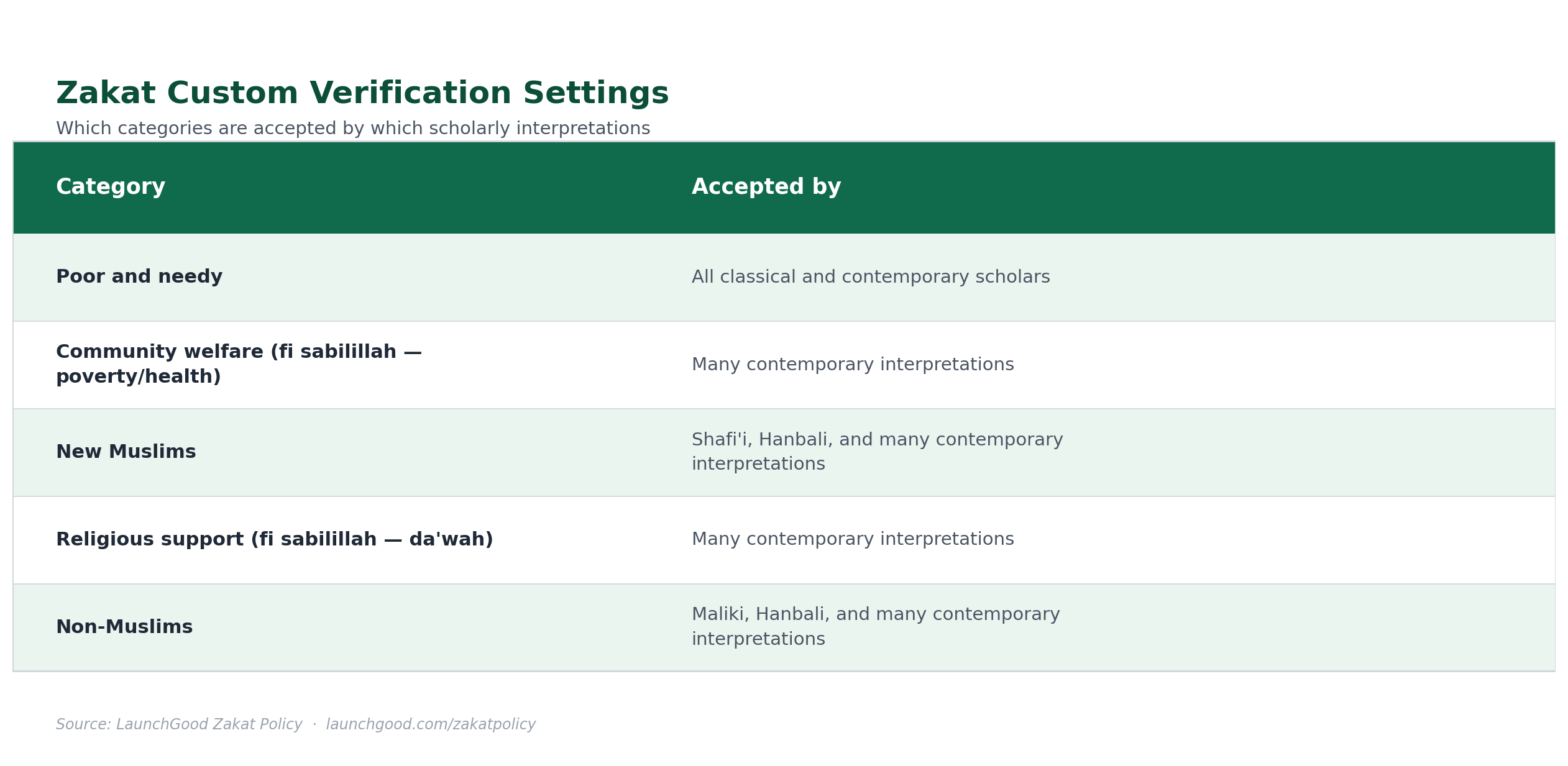
If you follow a stricter classical reading, you can limit your giving to just the first row. If you're comfortable with the broader contemporary position, you can enable all five.
Can you give Zakat to family members?
Yes, under specific conditions — and it's specifically encouraged, since it fulfills two things at once: the Zakat obligation itself, and silat ar-rahm (maintaining family ties).
Can receive Zakat (if they meet eligibility criteria and aren't financially dependent on you): siblings, aunts and uncles, nephews and nieces, cousins, step-relatives.
Cannot receive Zakat (because you're already religiously obligated to support them, so it wouldn't be a genuine transfer of ownership): parents and grandparents, children and grandchildren, spouses.
How LaunchGood verifies a Zakat campaign
Every fundraiser that selects the Zakat-eligible option goes through individual review by LaunchGood's Zakat team, checked against the policy above. Campaigns that pass receive a Zakat-Verified badge — donors can't apply this badge themselves, and organizers who add their own unauthorized badge to a cover photo, profile, or pitch may have their campaign removed.
The policy itself was built with named scholarly input, not just internally:
- The positions of all four madhabs were researched and compiled by Shaykh Omar Baig, who holds a bachelor's degree in Islamic Law from the Faculty of Shari'ah in Madinah and a master's in Islamic Finance from INCEIF University, and currently teaches Fiqh and Hadith at Darul Uloom Canada.
- Each madhab's definitions were separately reviewed by a dedicated scholar: Mufti Wahajuddin (Hanafi, Michigan), Shaykh Ma'an Dabbaagh (Maliki, UK), Shaykh Ibrahim Khidr (Shafi'i, Georgia), and Shaykh Abdullah Ashraf (Hanbali, Texas).
These scholars reviewed the category definitions for their respective madhab but don't participate in the day-to-day verification of individual campaigns.
Important limitation to know: LaunchGood verifies that a campaign's stated purpose fits Zakat-eligible criteria — it does not review the organizer's internal accounting or how funds are actually distributed after the campaign closes. Donors are responsible for their own due diligence and for following up with organizers on accountability.
Frequently asked questions
What are the eight categories of Zakat recipients?The poor, the needy, Zakat administrators, those whose hearts are to be reconciled, freeing captives, debtors, those in the cause of Allah (fi sabilillah), and the traveler — as named in Surah At-Tawbah (9:60).
Can Zakat fund a water well or community infrastructure project?Not under the poor/needy category, since that requires direct individual ownership transfer. It can qualify under fi sabilillah instead, if it alleviates poverty or improves health for a needy Muslim community without making individuals direct owners of the assets.
Can I give Zakat to my parents or children?No. You're already religiously obligated to support them, so it wouldn't represent a genuine transfer of ownership.
Can I give Zakat to my siblings or cousins?Yes, if they're otherwise Zakat-eligible and not financially dependent on you.
Does a fundraiser have to be 100% Zakat to get verified?No. Campaigns collecting a mix of Zakat and non-Zakat donations can still get verified, using wording like: "All Zakat donations will go toward [eligible use]. All other donations will go toward [cause] as Sadaqah."
If my fundraiser isn't Zakat-eligible, can it still accept donations?Yes — ineligible fundraisers can still collect donations freely; they just can't carry the Zakat-Verified badge, and funds can be distributed unconditionally.
Do credit card processing fees count as part of my Zakat donation?No. Processing fees (typically around 2.9% + $0.30 per transaction) are separate from your Zakat amount. It's best practice to add roughly an extra 3% on top of your intended Zakat amount to cover this.
Does LaunchGood take a cut of Zakat donations?No — LaunchGood charges 0% platform fees. Donors have the option to leave an optional tip at checkout to support LaunchGood's operations, but it isn't taken from the donation itself.
This guide summarizes LaunchGood's official Zakat verification policy. For specific questions about a campaign's eligibility or the verification process, contact LaunchGood's Zakat Team. And Allah knows best.
Passionate about all things marketing.